The Godfather
An epic gangster film chronicling the Corleone family's rise and fall.

Miguel Discart · CC BY-SA 2.0
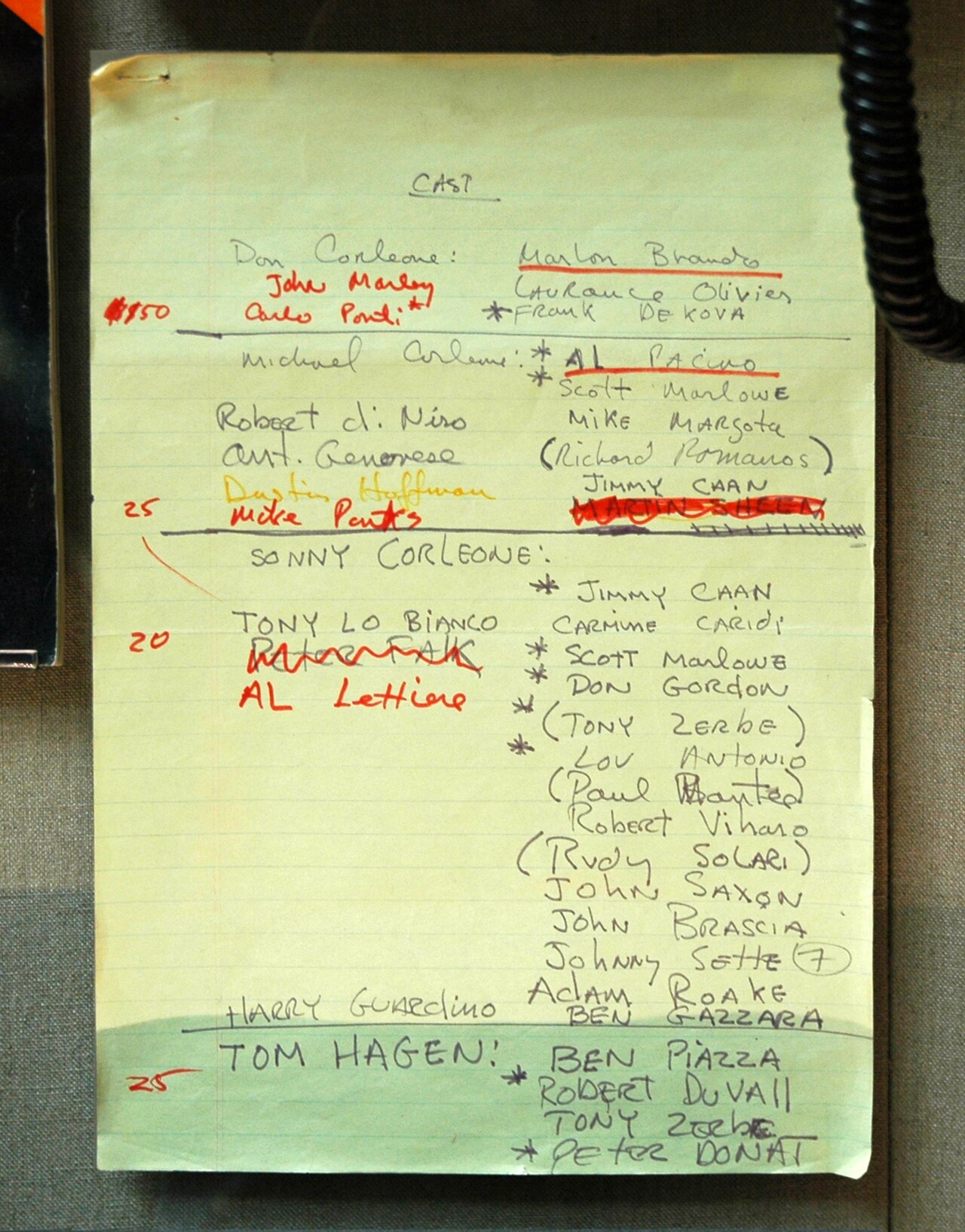
It is the first installment in The Godfather trilogy, chronicling the Corleone family under patriarch Vito Corleone and the transformation of his youngest son, Michael Corleone from reluctant outsider to ruthless Mafia boss. The film features an ensemble cast including Marlon Brando, Al Pacino, James Caan, Richard Castellano, Robert Duvall, Sterling Hayden, John Marley, Richard Conte, and Diane Keaton.
- director
- Francis Ford Coppola
- screenwriters
- Francis Ford Coppola and Mario Puzo
- studio
- Paramount Pictures
- academy_awards_won
- Best Picture, Best Actor (Marlon Brando), Best Adapted Screenplay
Lore & Background
Studio executives had trouble finding a director; the first few candidates turned down the position before Coppola signed on, but disagreement followed over casting several characters, particularly Vito (Marlon Brando) and Michael (Al Pacino). Filming took place primarily in locations around New York City and Sicily, and was completed ahead of schedule. The score was composed principally by Nino Rota, with additional pieces by Carmine Coppola. The film was acclaimed by critics and audiences, who praised its performances—particularly those of Brando and Pacino—direction, screenplay, story, cinematography, editing, score, and portrayal of the Mafia. At the 45th Academy Awards, the film won Best Picture, Brando won Best Actor, and Puzo and Coppola won for Best Adapted Screenplay. In addition, the seven other Oscar nominations included Pacino, Caan, and Duvall, all for Best Supporting Actor, and Coppola for Best Director. The Godfather is regarded as one of the greatest and most influential films ever made, as well as a landmark of the gangster genre. It was selected for preservation in the U.S. National Film Registry of the Library of Congress in 1990, being deemed 'culturally, historically, or aesthetically significant' and is ranked the second-greatest film in American cinema (behind Citizen Kane) by the American Film Institute.
Reader's Guide
The Godfather is regarded as one of the greatest and most influential films ever made, as well as a landmark of the gangster genre. It launched the successful careers of Coppola, Pacino, and other relative newcomers in the cast and crew. The film was selected for preservation in the U.S. National Film Registry of the Library of Congress in 1990, being deemed 'culturally, historically, or aesthetically significant' and is ranked the second-greatest film in American cinema (behind Citizen Kane) by the American Film Institute. Its legacy includes its portrayal of the Mafia, its ensemble performances, and its enduring influence on filmmaking. The Godfather remains a touchstone for epic storytelling and character-driven crime drama.
Did You Know?
- The film was completed ahead of schedule.
- Marlon Brando won the Academy Award for Best Actor for his role as Vito Corleone.
Production Journey & Title Change
The film's path to the screen was anything but straightforward. Originally conceived under the title Godfather, the project was forced to rename itself to Varalaru — a Tamil word meaning History — after the Government of Tamil Nadu moved to exempt tax on films carrying Tamil-language titles. This bureaucratic wrinkle gave the neo-noir thriller a distinctly local identity. The production stretched across two years before the film finally hit theaters on 20 October 2006, timed for the Diwali holiday. The project was produced by S. S. Chakravarthy under the NIC Arts banner and co-written and directed by K. S. Ravikumar. The creative origins trace even further back: director R. Sundarrajan had originally scripted the base story for Kamal Haasan under Sivaji Productions, but Haasan declined, feeling the material would cast him as a womaniser. Ravikumar himself had pitched two scripts to Haasan in late 1999, including a transgender-themed triple-role story called Madana that Rajinikanth had agreed to take on if Haasan passed. The tangled history of who was attached to what speaks to the film's long gestation before it finally found its director and lead.
Narrative Architecture & The Twin Twist
At its core, the film is a neo-noir action thriller built around a single actor — Ajith Kumar — playing a father and his two twin sons in a triple-lead structure. The narrative unfolds in layers: what appears to be a straightforward romance between a spoiled rich son and a college student in a sacred village slowly unravels into a psychological thriller. The pivotal twist reveals that the twin brother Jeeva has been impersonating his sibling Vishnu, taking over his identity, draining bank accounts, and attempting violence against their father. The backstory, delivered through a flashback, recontextualizes everything: the wheelchair-bound multimillionaire Shivashankar was once a Bharatanatyam dancer whose effeminate manner led to a public humiliation at his wedding, the death of his mother, and a traumatic act that resulted in the twins' birth. The film's structure deliberately withholds the truth until the audience sees the real events during the closing credits, making the first half a deliberate misdirection.
Creative Team & Musical Score
The film assembled a formidable creative slate behind the camera. K. S. Ravikumar handled both co-writing and directing, while S. S. Chakravarthy produced the project under the NIC Arts banner. The supporting cast included Asin, Kanika, Ramesh Khanna, Suman Setty, Sujatha, and M. S. Baskar in key secondary roles. Perhaps most notably, the soundtrack and background score were composed by A. R. Rahman, lending the neo-noir thriller a rich musical texture that elevated its atmospheric tension. Ajith Kumar carried the enormous burden of the triple-lead, portraying the wheelchair-using patriarch Shivashankar alongside both twin sons, Vishnu and Jeeva, requiring him to differentiate three distinct personalities within a single performance. The film's genre blend — action, thriller, neo-noir — demanded a versatile ensemble and a score that could shift between romantic interludes in a sacred village and the darker, more violent undercurrents of the family drama.
Box Office Success & International Remakes
Released on the eve of Diwali in October 2006, the film became the highest-grossing movie of the year in Tamil Nadu, finishing as the second-highest-grossing Tamil film of 2006 behind Vettaiyaadu Vilaiyaadu. Its commercial strength extended well beyond the Tamil-speaking audience. The story was remade in Kannada under the original working title Godfather, in Burmese as Nat Khat Mhar Tae Tite Pwal, and in Odia as Tu Mo Dehara Chhai. This multi-language remake trajectory — spanning South Indian, Southeast Asian, and East Indian markets — is a testament to the universal appeal of the twin-identity thriller at the film's heart. The fact that the Kannada version retained the Godfather title while the Tamil original had been forced to adopt Varalaru for tax purposes adds an ironic footnote to the film's naming history. For a neo-noir action thriller built around a single actor's triple performance, the breadth of its commercial footprint across 2006 and the subsequent remake cycle speaks to a story that resonated across linguistic and cultural boundaries.
Gallery

Frequently Asked Questions
Who stars in The Godfather?
The ensemble cast features Marlon Brando as Vito Corleone, Al Pacino as Michael, James Caan as Sonny, Robert Duvall as Tom Hagen, Diane Keaton as Kay Adams, and Richard Castellano as Luca Brasi, among others.
More in Film History 1-16
Spotted an error? Know more?
This is a living reference — every entry is fact-audited, and reader corrections feed straight into our audit queue. Suggest an edit · See this site's audit record